Product insight: Plumbed helps commerce teams build and operate integrations
For retailers and marketplace sellers, connecting storefronts, ERP, product data and sales channels can create a web of integrations to maintain. Plumbed brings integration building, monitoring and repair into one managed lifecycle.
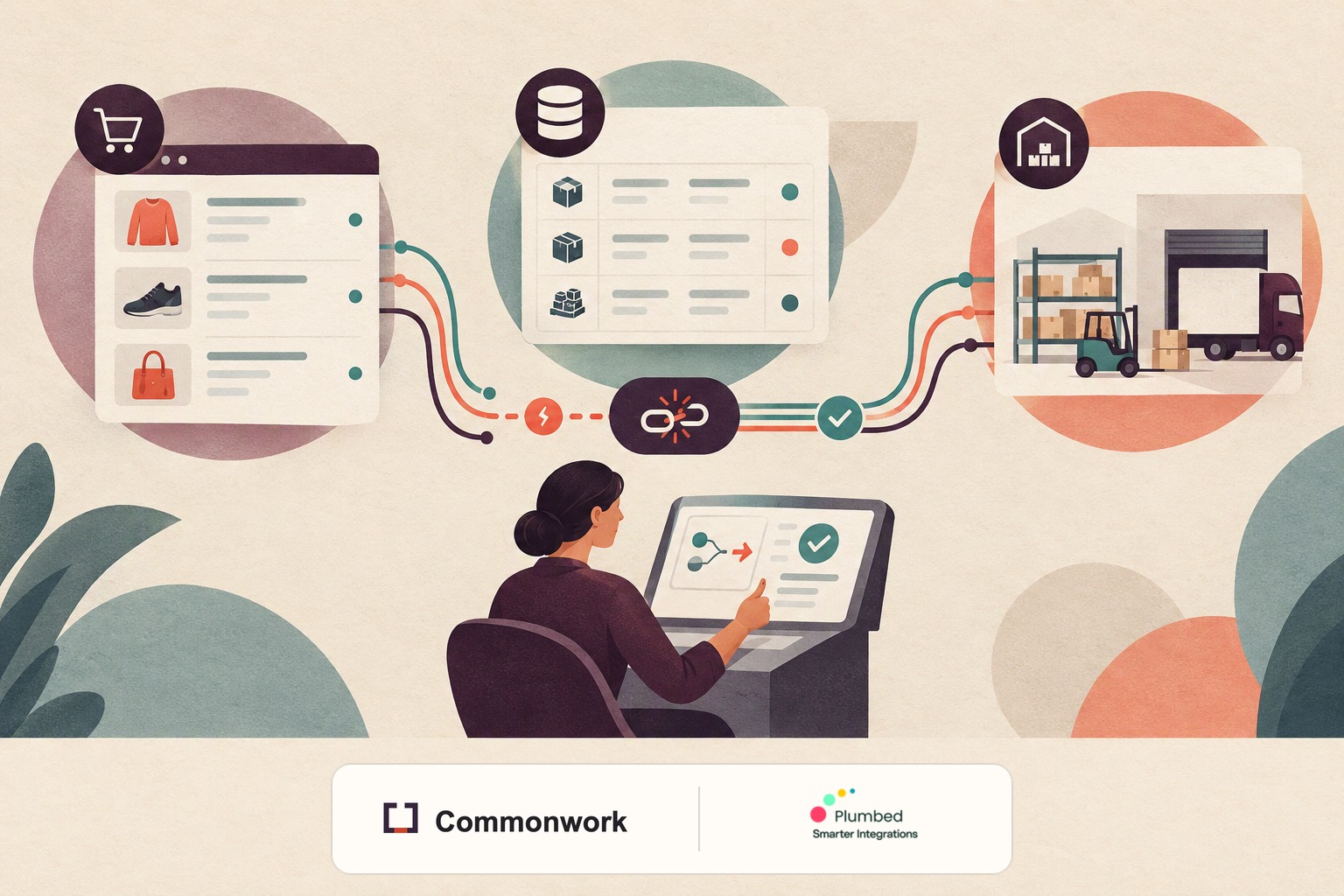
The problem: commerce systems need to stay in sync
Retail and ecommerce operations depend on information moving between storefronts, ERP and inventory systems, product information management, order management, warehouses and marketplaces. When APIs or marketplace requirements change, a connection may need new mappings or troubleshooting. Teams can then spend time fixing data flows instead of launching channels and serving customers.
What Plumbed does
The Plumbed integration lifecycle consists of three parts: Build, Operate and Heal. Teams can use connectors, templates and AI assistance to design, map, test and launch integrations. Operate monitors data flows and detects errors or API and schema changes. Heal uses AI-assisted diagnosis to identify issues and prepare governed fixes for review and approval.
Plumbed's marketplace integration offer connects commerce systems with marketplace channels. Product data, prices, inventory, orders, fulfilment updates, returns and refunds can be part of those flows. Published deployment options include managed cloud, on-premise and custom infrastructure.
Who it is for
Plumbed is relevant to retailers, brands and marketplace sellers expanding into new sales channels, as well as commerce and SaaS teams managing multiple connected systems or external partners. It is designed for environments where integrations need ongoing monitoring and maintenance, not just a one-time connection.
Using Plumbed in your environment
Start with one high-priority workflow: for example, synchronising product data, price and inventory between an ERP or PIM, an online shop and a marketplace. Map the source and destination fields and business rules, then use Plumbed to build and test the connection.
Once it is running, use monitoring to keep track of sync health, errors and changes in the connected systems. Set the review and approval process for proposed fixes to match the importance of the data and the operational controls your team needs. When the first workflow is established, extend the approach to orders, fulfilment, returns or another marketplace.
The potential benefits are faster integration and channel launches, better visibility into data flows, and less recurring manual effort to diagnose and maintain connections. Plumbed's approach brings these activities into a Build, Operate and Heal lifecycle.
Explore Plumbed in the Commonwork catalogue for its product profile: https://commonwork.network/catalogue?product=plumbed
Sources
Plumbed: AI-assisted enterprise integrations — https://www.plumbed.io/
Plumbed: Autonomous integration operations — https://www.plumbed.io/autonomous-integration-operations.html
Plumbed: Integration features — https://www.plumbed.io/features.html
This overview summarizes product information published by Plumbed.